Logan Becker · 5 September 2026
Revealing Air Quality Patterns from Lichen Responses in Persistent Fog Areas
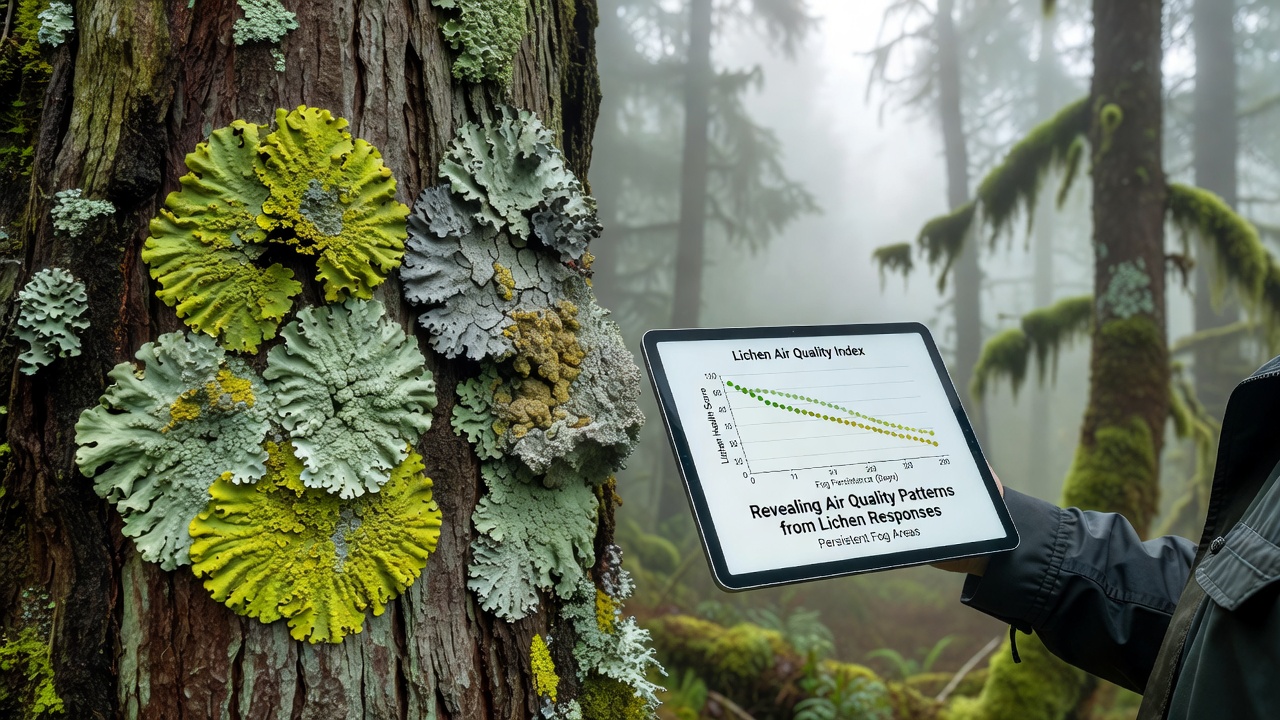
Researchers studying persistent fog regions have documented how lichen communities respond to atmospheric conditions over extended periods, and these responses provide measurable indicators of air quality variations across multiple sites. Studies conducted in coastal and mountainous zones where fog persists for weeks at a time show that certain lichen species absorb pollutants directly from the moisture-laden air, which alters their growth rates, color, and species composition in patterns that align with local emission sources and wind directions. Data collected through September 2026 from monitoring stations in the Pacific Northwest and parts of Northern Europe indicate that fog events concentrate nitrogen compounds and heavy metals on lichen surfaces at rates up to three times higher than in clear-weather conditions, creating distinct spatial gradients that researchers map through repeated field surveys.
Lichen Biology and Sensitivity to Atmospheric Inputs
Lichens function as symbiotic organisms combining fungi and algae or cyanobacteria, and their lack of protective cuticles allows them to take up nutrients and contaminants directly from precipitation and fog. In areas where fog forms regularly, species such as Usnea and Lobaria exhibit measurable changes in chlorophyll content and thallus thickness when exposed to elevated sulfur dioxide or ozone levels, according to long-term records maintained by government agencies. These biological shifts occur because fog droplets remain suspended longer than rain, increasing contact time between pollutants and lichen tissues, which leads to accumulation patterns that reflect both regional transport and local sources like agricultural ammonia or industrial emissions.
Monitoring Methods in Fog-Prone Zones
Field teams deploy standardized lichen surveys that record frequency, abundance, and health metrics at fixed plots, then correlate those observations with air quality data from nearby stations. Passive samplers placed alongside lichen transects collect fog water samples for chemical analysis, revealing how pH levels and ion concentrations in fog correlate with declines in sensitive species. One study revealed that plots experiencing more than 150 fog hours per month showed a 40 percent reduction in lichen diversity when nitrogen deposition exceeded 10 kilograms per hectare annually, while plots with fewer fog events maintained stable communities under similar deposition loads. Researchers process these datasets using statistical models that isolate fog duration as a variable, which helps separate its effects from those of temperature or light availability.
Regional Case Examples and Data Patterns
Along the Oregon coast, observers note that lichen communities shift toward pollution-tolerant species such as Xanthoria near highways, whereas interior fog belts farther from roads retain higher proportions of Platismatia. In the Scottish Highlands, similar gradients appear around former industrial sites, where historical sulfur emissions left lasting signatures in lichen isotope ratios that current monitoring programs continue to track. The United States Environmental Protection Agency maintains a database linking these biological responses to federal air monitoring networks, allowing analysts to validate model predictions against empirical observations collected across multiple fog seasons. Meanwhile, Australian researchers have applied comparable techniques in the Great Dividing Range, where persistent valley fog interacts with eucalyptus-derived volatile organic compounds to produce secondary aerosol patterns that affect lichen health in measurable ways.
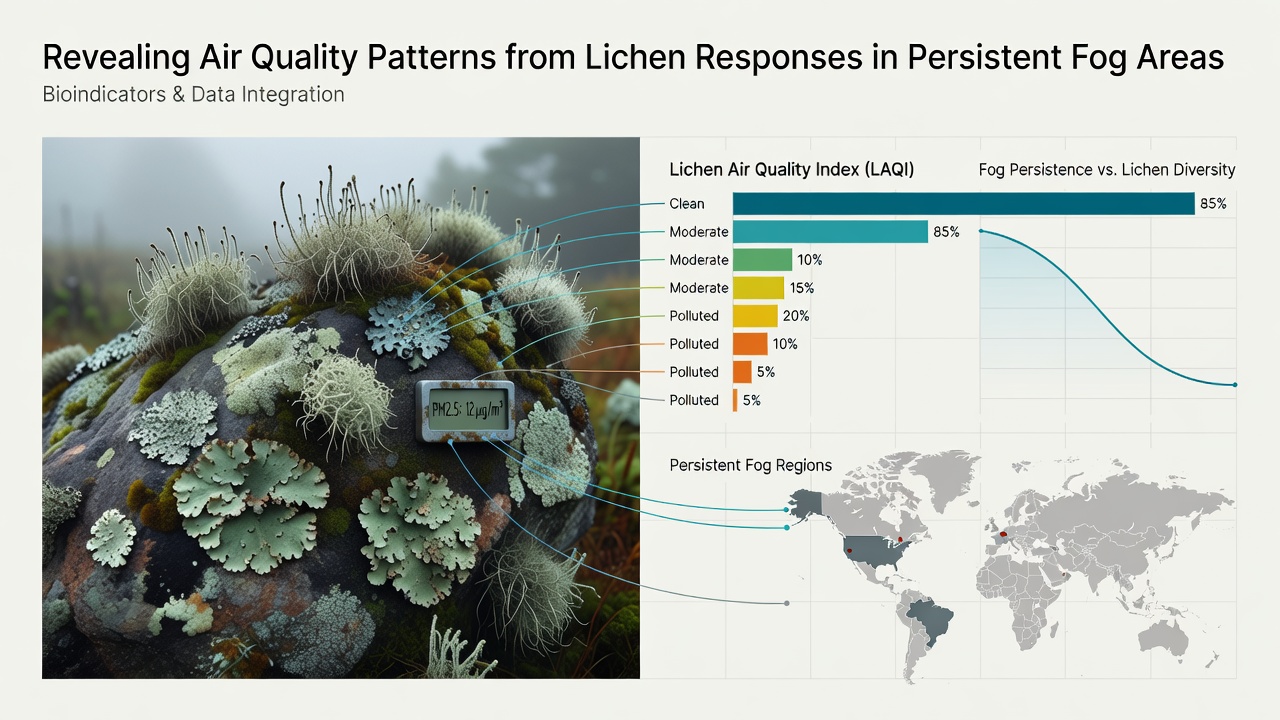
September 2026 updates from multi-site networks show that fog frequency increased in several monitored regions compared with the previous five-year average, coinciding with shifts in lichen community structure that researchers attribute to both meteorological trends and changing emission profiles. These updates integrate satellite-derived fog maps with ground-level lichen inventories, producing composite indices that highlight zones where air quality improvements lag behind regulatory targets. The approach provides cost-effective coverage in remote or rugged terrain where continuous instrumental monitoring remains impractical, and it supplies early signals of ecosystem stress before visible damage appears in vascular plants.
Integration with Broader Air Quality Frameworks
Environmental agencies incorporate lichen-derived data into larger assessments that also include particulate matter readings and deposition estimates, creating layered pictures of how persistent fog modifies pollutant behavior. In Canada, Environment and Climate Change Canada has funded projects that combine lichen mapping with atmospheric modeling to forecast deposition hotspots during prolonged fog events, which informs decisions about emission controls for nearby facilities. The resulting datasets help distinguish between pollutants transported over long distances and those generated locally, because lichen uptake responds differently to each category under high-humidity conditions. Analysts note that species with high cation-exchange capacity accumulate metals more rapidly in fog, producing concentration gradients that point toward specific source directions when plotted on geographic information systems.
Future Applications and Data Expansion
Continued expansion of lichen monitoring networks in fog-prone areas will likely add temporal resolution through repeated seasonal sampling and citizen-science contributions that follow standardized protocols. Automated image analysis of lichen photographs taken at fixed points offers one avenue for scaling observations without proportional increases in field time, while laboratory experiments refine understanding of dose-response relationships under controlled fog simulations. These developments support more precise attribution of air quality changes to particular meteorological or anthropogenic drivers, especially in regions where fog acts as a vector for both natural and human-derived compounds.
Conclusion
Persistent fog areas function as natural laboratories where lichen responses reveal air quality patterns through biological accumulation and community shifts that instrumental records alone often miss. Research programs operating through September 2026 and beyond continue to refine these methods, linking field observations to regulatory datasets and expanding geographic coverage across continents. The resulting information supports targeted interventions by identifying locations where fog-mediated deposition warrants closer attention, while also documenting recovery trajectories in areas where emission reductions have taken effect. This biological approach complements existing monitoring infrastructure and extends its reach into environments where conventional equipment faces logistical constraints.